You are standing in a Baltimore rowhome, staring at a patch of discolored hardwood floor. Maybe it is dried blood from a fall, or perhaps the dark stain that spread after a family member passed away unnoticed for three days. The instinct is to grab a mop and some bleach, to get the scene back to normal as fast as possible. That instinct, while understandable, is the most expensive mistake you can make. Every hour of delay transforms a contained biohazard incident into a full-scale structural contamination problem, multiplying cleanup costs by a factor of ten and introducing serious long-term health risks for everyone who enters the property.
The question of how quickly biohazard cleanup should begin after an incident is not a matter of convenience or scheduling. It is a matter of hours, not days. In the dense urban environment of Baltimore, where historic rowhomes share common walls and aging HVAC systems can circulate airborne pathogens across multiple units, the window for safe and effective remediation is remarkably short. Waiting even twelve hours can mean the difference between a straightforward surface-level decontamination and a complex project involving structural material replacement, microbial remediation, and odor migration control. Understanding this timeline is the first step toward protecting both the people who live in the property and the asset value of the home itself.
The Critical Time Window for Biohazard Remediation
Professional biohazard remediation standards, as defined by the IICRC S540 standard for trauma and crime scene cleanup, establish that response should begin within two to four hours of notification for most incidents involving bloodborne pathogens or other bodily fluids. This is not an arbitrary benchmark. The science behind it is rooted in the behavior of biological materials once they leave the body. Blood, for instance, begins to coagulate and dry within minutes, but the pathogens it carries — hepatitis B, hepatitis C, HIV — remain viable on surfaces for days or even weeks under the right conditions. The primary goal of rapid response is to contain the affected area before biological materials seep into porous substrates like unsealed wood, drywall, or grout lines.
Baltimore’s climate adds an extra layer of urgency. The Mid-Atlantic region experiences high relative humidity, often above 60 percent during the summer months. This humidity slows the natural drying process of biological fluids, keeping them in a liquid state longer and allowing deeper penetration into porous materials. In a typical Baltimore rowhome, where original wide-plank hardwood floors sit directly on joists above damp crawl spaces, a blood spill that sits for six hours can wick into the wood grain and reach the subfloor below. Once biological material reaches structural elements, the only remediation option is removal and replacement, a process that quickly escalates from a few hundred dollars to several thousand.
Step-by-Step Professional Remediation Workflow
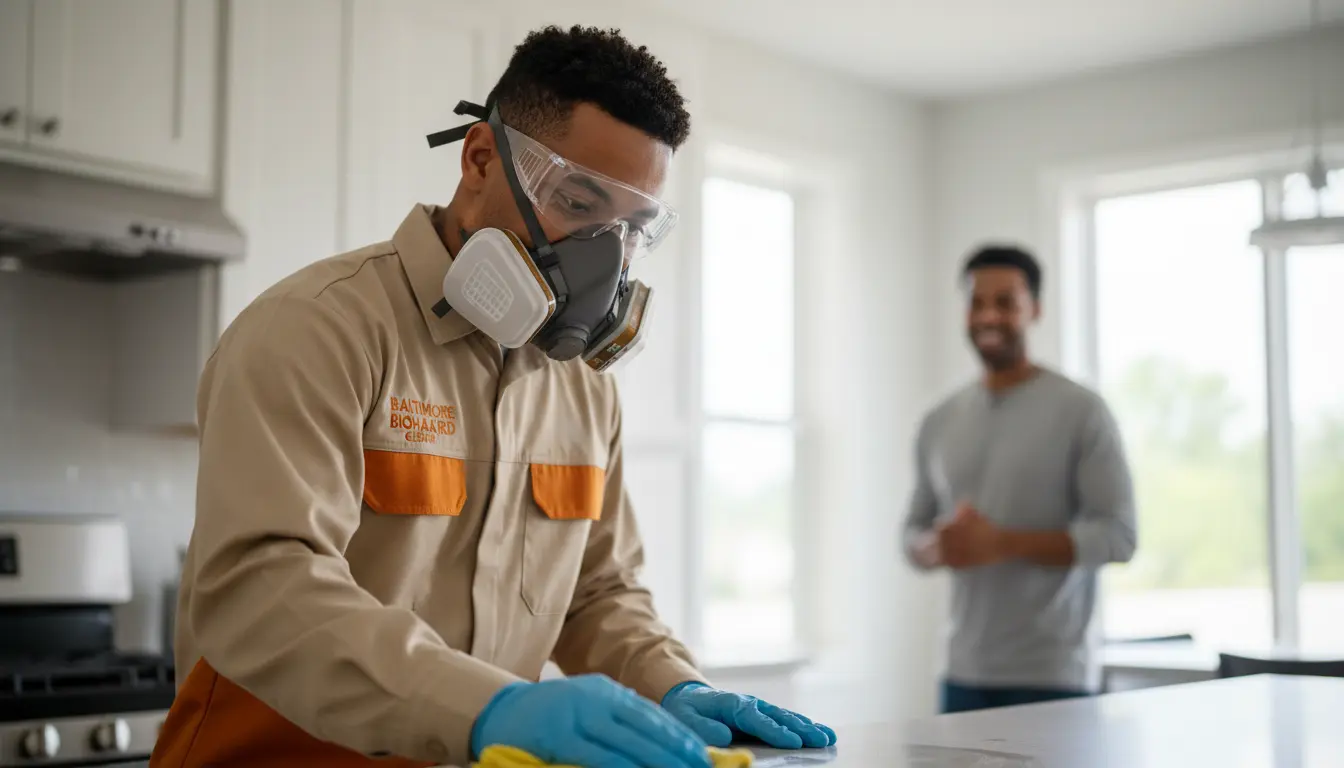
Understanding the professional workflow helps clarify why speed matters so much. The first step upon arrival is a comprehensive risk assessment. Technicians evaluate the type and volume of biohazardous material, the porosity of the affected surfaces, and the potential for airborne contamination. This assessment determines the level of personal protective equipment required, the containment strategy, and the specific chemical agents needed. In Baltimore, where many properties date back to the early 1900s and contain lead paint or asbestos in older finishes, the assessment also includes testing for these secondary hazards before any physical work begins.
Once the assessment is complete, the team establishes a containment zone using polyethylene sheeting and negative air machines. These machines create negative pressure within the containment area, ensuring that airborne particles — including viral particles and bacterial spores — do not migrate to other parts of the home. This is particularly critical in Baltimore’s attached rowhome configuration, where air can travel freely through shared attics and wall cavities. After containment, the physical removal of biohazardous materials begins. Technicians use hospital-grade disinfectants with verified kill claims against bloodborne pathogens, applying them with a minimum dwell time specified by the manufacturer, typically ten to fifteen minutes.
The final stage of the technical process involves adenosine triphosphate testing, commonly called ATP testing. This is a fluorescence-based test that measures the presence of organic material on a surface after cleaning. A reading below a specific threshold, usually 10 to 30 relative light units depending on the surface, confirms that the area is biologically clean. This is a far more rigorous standard than visual inspection, which cannot detect microscopic biological residues. Only after passing ATP testing does the team proceed to structural encapsulation, which may involve applying antimicrobial sealants to porous surfaces that cannot be removed. Baltimore Biohazard Cleanup follows this exact workflow for every project, ensuring that every site meets the highest standards of safety and cleanliness.
Professional Remediation vs. Standard Janitorial Cleaning
The difference between professional biohazard remediation and what most people think of as cleaning is vast. The table below illustrates the key distinctions across critical metrics.
| Feature / Metric | Professional Biohazard Remediation | Standard Residential Cleaning |
|---|---|---|
| Regulatory Compliance | OSHA 29 CFR 1910.1030, EPA waste disposal, DOT transport | None |
| Pathogen Elimination | EPA-registered hospital-grade disinfectants, verified by ATP testing | Household bleach or all-purpose cleaner, no verification |
| Structural Assessment | Full porosity evaluation, moisture mapping, hidden seepage detection | Visual inspection only |
| Containment Protocol | Negative air pressure, HEPA filtration, physical barriers | None |
| Waste Disposal | Regulated medical waste stream, incineration | Household trash, illegal and dangerous |
| Insurance Documentation | Detailed chain-of-custody logs, photographic evidence, final clearance report | None |
Expert Diagnostic Insights for Property Owners
Experienced biohazard remediation specialists develop diagnostic skills that go far beyond what a standard visual inspection can reveal. One of the most important is the ability to detect hidden biological seepage. When blood or other bodily fluids pool on a surface, they often migrate along the path of least resistance, which may be underneath flooring, behind baseboards, or into the gaps between wall studs. A professional uses moisture meters and thermal imaging cameras to trace this migration path, identifying areas that require full removal rather than surface cleaning. In Baltimore rowhomes, where original plaster walls can wick moisture like a sponge, hidden seepage is the rule rather than the exception.
Another critical diagnostic principle is that porous materials almost always require replacement rather than cleaning. Drywall, unsealed wood, carpet, padding, and upholstery are all porous materials. When blood or other biological fluids penetrate these materials, the pathogens can lodge deep within the matrix, where surface cleaning cannot reach them. No amount of scrubbing or chemical application can make a porous material biologically safe after a significant biohazard exposure. The only safe solution is removal and disposal as regulated medical waste. This is a hard truth that many property owners resist, but accepting it early prevents the far worse outcome of a recurring odor or a future occupant contracting an illness from residual contamination.
The third diagnostic insight involves the use of negative pressure to prevent cross-contamination. Many people assume that simply closing a door is enough to contain a biohazard scene. In reality, the natural airflow of a home, driven by HVAC systems and temperature differentials, can carry airborne particles from a containment zone to other rooms within minutes. Professional remediation teams use negative air machines to create a pressure differential that forces air to flow into the containment zone rather than out of it. This airflow is HEPA-filtered before being exhausted, ensuring that no contaminants escape. In a Baltimore property with a shared HVAC system, this protocol is non-negotiable for protecting the health of occupants in adjacent units.
Despite these clear standards, property owners frequently make mistakes that compound the problem. Using household bleach on biological material is perhaps the most common error. Bleach is a corrosive chemical that can damage surfaces and release toxic fumes when mixed with organic matter. It also has a short shelf life and loses efficacy quickly once diluted. Professionals use EPA-registered hospital-grade disinfectants that are specifically formulated to kill bloodborne pathogens without damaging the underlying surface. Another common mistake is waiting for odors to dissipate naturally. The odor associated with decomposition is caused by volatile organic compounds released as tissue breaks down. These compounds are not just smelly; they are toxic and can indicate the presence of airborne pathogens. Waiting for the smell to go away means waiting for the contamination to spread further.
Allowing untrained personnel into a biohazard site is perhaps the most dangerous mistake. Friends, family members, or well-meaning neighbors who enter the scene without proper PPE and training are at immediate risk of exposure to bloodborne pathogens. They also risk tracking contaminants to other areas of the home on their shoes and clothing, expanding the scope of the contamination. Every person who enters a biohazard scene without training is a potential victim of a preventable illness.
Understanding Biohazard Cleanup Pricing
- Standard site mobilization fees in Baltimore typically range from $250 to $500. This covers the cost of dispatching a certified crew, transporting equipment, and setting up containment. These fees are non-negotiable and are applied to every project, regardless of size, because the equipment and training required are substantial.
- Hourly remediation rates generally fall between $150 and $300 per hour per technician. A standard trauma scene cleanup requires a team of three to five technicians and takes between four and eight hours for a contained scene. More complex projects, such as those involving decomposition or hoarding, can take multiple days.
- Specialized disposal costs for biohazardous waste are calculated by weight. Regulated medical waste disposal in Maryland costs approximately $0.50 to $1.50 per pound. A typical trauma scene generates 50 to 200 pounds of waste, including contaminated materials, PPE, and cleaning supplies. This waste must be transported by a licensed hauler to an authorized incineration facility, adding logistical costs to the disposal fee.
Three primary factors influence the final cost of a biohazard cleanup project. The first is the extent of structural material replacement required. If biological materials have seeped into subflooring, drywall, or insulation, those materials must be removed and replaced. This adds material costs, labor for demolition and reconstruction, and disposal fees for construction debris. The second factor is the total volume of biohazardous waste. Larger volumes require more disposal containers, more technician hours for packaging and transport, and higher disposal fees. The third factor is the necessity for specialized HVAC decontamination. If airborne contaminants have entered the ductwork of a home, the entire system must be cleaned and sanitized by a certified duct cleaning professional, adding another layer of cost and complexity.
Safety Standards and Certifications
The safety protocols governing biohazard remediation are not suggestions; they are legal requirements. OSHA’s Bloodborne Pathogens Standard, codified as 29 CFR 1910.1030, mandates that any employee with occupational exposure to blood or other potentially infectious materials must receive specific training, be offered the hepatitis B vaccine, and use appropriate PPE. Professional remediation companies must maintain written exposure control plans and provide annual refresher training to all technicians. These requirements exist because the consequences of exposure are severe. Hepatitis B can survive on surfaces for up to seven days, and hepatitis C can remain infectious for up to six weeks under the right conditions. HIV, while more fragile outside the body, still poses a risk for several hours after exposure.
Beyond OSHA compliance, professional companies adhere to the IICRC S540 standard for trauma and crime scene cleanup. This voluntary standard establishes best practices for everything from initial assessment to final clearance testing. It requires documentation of every step of the process, including photographs, chain-of-custody logs for waste, and final ATP test results. This documentation is critical for property owners who may need to file insurance claims or provide proof of proper remediation to future buyers. In Baltimore, where property transactions often involve older homes with complex histories, having a documented biohazard remediation file can be a significant asset when selling a property.
Authorized waste management services are another critical component of safety. In Maryland, biohazardous waste must be transported by a licensed medical waste hauler and disposed of at an authorized incineration facility. Improper disposal, such as placing biohazardous materials in household trash, is a violation of state and federal regulations and can result in significant fines. Professional companies maintain contracts with licensed haulers and provide clients with certificates of disposal, confirming that the waste was handled legally and safely.
How quickly should biohazard cleanup begin after an incident involving a deceased person who was not discovered for several days?
In cases of decomposition, the timeline for cleanup becomes even more compressed. The process of decomposition releases volatile organic compounds and biological fluids that can penetrate deeply into porous materials within hours. Professional response should begin immediately upon discovery. The longer the body has been present, the more extensive the contamination is likely to be. In Baltimore’s humid climate, decomposition accelerates, and odors can migrate through shared walls into neighboring units. Immediate containment and removal are essential to prevent structural damage and health risks.
Can I clean a small blood spill myself, or do I always need professional help?
For very small, contained spills — a few drops of blood on a non-porous surface like tile or glass — it may be possible to clean the area yourself using proper precautions. This includes wearing disposable gloves, using an EPA-registered disinfectant with a bloodborne pathogen claim, and following the manufacturer’s instructions for dwell time. However, if the blood has soaked into a porous surface like grout, wood, or carpet, professional remediation is required. The line between a manageable spill and a structural contamination problem is thin, and most property owners underestimate the degree of penetration. If you have any doubt, it is safer to call a professional.
What happens if I do not clean a biohazard scene quickly enough?
The consequences of delay escalate rapidly. Within the first few hours, biological fluids begin to dry and form a biofilm that adheres to surfaces, making removal more difficult. Within 24 hours, odors from decomposition or blood breakdown become noticeable and can attract pests. Within 48 to 72 hours, the risk of mold growth increases, adding a secondary contamination issue. Long-term, residual pathogens can pose a health risk to anyone who enters the property, including family members, tenants, and future buyers. The cost of remediation also increases dramatically as the scope of contamination expands.
How do I know if a biohazard cleanup company is properly certified?
Look for certifications from the IICRC, specifically the S540 trauma and crime scene cleanup designation. Ask whether the company holds an OSHA compliance certificate and whether its technicians have completed OSHA-approved bloodborne pathogens training. Verify that the company uses ATP testing for final clearance and provides documented chain-of-custody logs for waste disposal. A reputable company will be transparent about its certifications and will provide references upon request. Baltimore Biohazard Cleanup holds all relevant certifications and maintains a record of compliance that is available for client review.
Professional Biohazard Remediation in Baltimore
The window for safe and effective biohazard cleanup is measured in hours, not days. Every moment of delay increases the risk of structural damage, health hazards, and escalating costs. In Baltimore, where the climate and historic building stock create unique challenges, professional remediation is not a luxury; it is a necessity for protecting property value and human health. The technical workflow — from initial risk assessment and containment through ATP testing and structural encapsulation — is designed to ensure that every site is restored to a safe, habitable condition.
Baltimore Biohazard Cleanup brings decades of combined experience to every project, combining rigorous adherence to industry standards with a compassionate understanding of what property owners are going through. The team responds 24 hours a day, seven days a week, recognizing that biohazard incidents do not follow a business schedule. When you need professional, discreet, and technically excellent biohazard remediation in Baltimore, you need a team that understands both the science and the human element of the work.