The call came in at 3:47 AM. A third-floor apartment in a Fells Point rowhouse had been vacant for eight days before the landlord discovered the source of the odor. A tenant had died alone, and the summer humidity had already accelerated biological breakdown beyond what any household cleaner could handle. By the time the first responders left, the scene required a specialized response that most property owners don’t know exists until they need it. That’s when emergency biohazard cleanup services near Downtown Baltimore become the only safe option.
Professional biohazard remediation is not a luxury—it’s a public health necessity. In Baltimore’s dense urban landscape, where historic rowhomes share walls and ventilation systems, a single contaminated space can threaten neighboring units. The risks include airborne pathogens, bloodborne viruses, and structural contamination that standard cleaning protocols cannot address. Without proper containment, decomposition fluids can seep into flooring and drywall, creating long-term health hazards and reducing property value.
Baltimore Biohazard Cleanup provides the technical expertise, regulatory compliance, and compassionate discretion required for these sensitive situations. Our teams are IICRC-certified and trained in OSHA Bloodborne Pathogens Standard 29 CFR 1910.1030, ensuring every site is restored to a safe, habitable condition. Whether the trigger is an unattended death, a crime scene, or a hazardous waste spill, we respond 24/7 to protect both the property and the people who occupy it.
Understanding the Remediation Workflow
Every emergency biohazard cleanup follows a rigorous, step-by-step process designed to eliminate all biological hazards and restore the environment. The first stage is a comprehensive risk assessment. Technicians evaluate the extent of contamination, identify the types of biohazardous materials present (blood, bodily fluids, tissue, or microbial growth), and check for structural damage. In Baltimore, this assessment must account for the age of the building—many Downtown rowhomes were built before modern ventilation standards, which means hidden seepage behind walls is common.
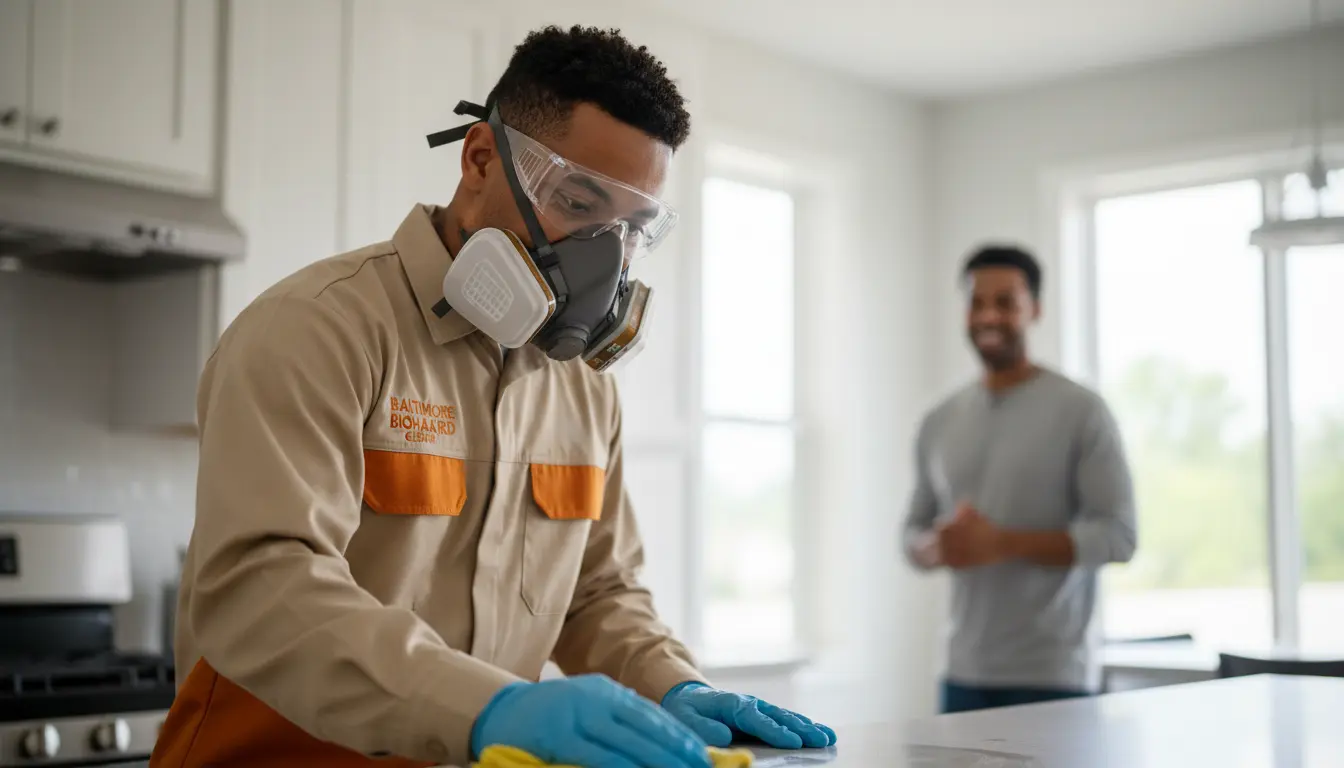
Once the assessment is complete, the team establishes a containment zone using negative air pressure machines. These industrial-grade units create a vacuum that prevents airborne contaminants from spreading to clean areas of the property. Every technician then dons full personal protective equipment (PPE), including Tyvek suits, respirators, face shields, and puncture-resistant gloves. This protocol is non-negotiable: it protects the workers and prevents cross-contamination.
Physical Removal and Chemical Treatment
All visible biohazardous materials are removed manually using specialized forensic cleaning tools. Porous materials such as carpet, drywall, and insulation that have absorbed biological fluids are cut out and disposed of as regulated medical waste. Non-porous surfaces are scrubbed with hospital-grade disinfectants that are EPA-registered for bloodborne pathogens. The type of disinfectant matters: quaternary ammonium compounds are effective against many viruses, but bleach-based solutions are required for certain pathogens. Our teams use adenosine triphosphate (ATP) testing to verify that all biological residue has been eliminated—a method that measures the presence of organic material on surfaces.
Baltimore’s Mid-Atlantic climate adds another layer of complexity. High humidity during the summer months can cause decomposition to accelerate, producing odors that migrate quickly through shared walls. We use enzyme-based treatments to neutralize the organic compounds responsible for persistent smells, followed by ozone or hydroxyl generators to break down volatile organic compounds (VOCs) trapped in the air. This step is critical for making a property habitable again, especially in multi-unit buildings where odor complaints can escalate into tenant disputes.
Professional Remediation vs. Standard Janitorial Cleaning
Many property owners mistakenly believe that bleach and a mop are sufficient for biohazard scenes. The table below highlights the fundamental differences between professional biohazard remediation and standard residential cleaning.
| Feature / Metric | Professional Biohazard Remediation | Standard Residential Cleaning |
|---|---|---|
| Regulatory Compliance | Follows OSHA, EPA, and IICRC S540 standards; proper waste disposal via licensed medical waste transporters | No regulatory oversight; cleaning chemicals may not meet pathogen elimination requirements |
| Pathogen Elimination | Uses EPA-registered disinfectants with verified contact times; ATP testing for verification | Does not test for biological residue; household cleaners may only disinfect, not sterilize |
| Structural Assessment | Identifies hidden contamination behind walls, under flooring, and in HVAC systems; removes affected materials | Cleans only visible surfaces; does not address porous material absorption |
| Odor Neutralization | Employs enzyme treatments, ozone generators, and hydroxyl machines to eliminate VOCs at the molecular level | Masking agents or air fresheners only; does not address the source of the odor |
| Waste Disposal | All biohazardous waste is transported to approved incineration facilities under strict chain-of-custody protocols | Regular trash disposal; illegal and dangerous for biological materials |
Expert Insights for Property Owners and Managers
With over a decade of field experience in Baltimore, I’ve identified three diagnostic techniques that can prevent a minor contamination from becoming a major restoration project. First, use a moisture meter to detect hidden biological seepage. When a death or spill occurs, fluids can travel under baseboards and into subflooring before any visible stain appears. A pinless moisture meter will reveal elevated readings in areas that look dry, allowing technicians to target those zones for removal rather than hoping the issue disappears.
Second, understand that porous materials are never salvageable after biological contamination. Gypsum board, carpet padding, and untreated wood absorb blood and other fluids on a cellular level. Even if the surface appears clean, pathogens can remain viable inside the material. The IICRC standard requires removal of all porous items that have been saturated with category 3 (highly contaminated) water or bodily fluids. Attempting to clean them only creates a false sense of safety and increases the risk of long-term microbial growth.
Third, always establish negative pressure before any work begins. This is not just a precaution—it’s a containment strategy. Without it, microscopic particles become airborne and can settle on furniture, clothing, and ductwork. In a Baltimore rowhome with shared walls, the neighbors’ unit could be contaminated without anyone realizing it. We use HEPA-filtered negative air machines to create a pressure differential that keeps contaminants inside the work zone.
Common Mistakes That Cost Time and Money
One of the most frequent errors I see is property owners using household bleach on biological materials. While bleach is a disinfectant, it is not a cleaner—it can cause proteins in blood to coagulate and bond to surfaces, making removal more difficult. Worse, bleach can react with other chemicals to produce toxic gases. The correct approach is to use an enzymatic cleaner first to break down organic matter, then apply a hospital-grade disinfectant for pathogen kill.
Another mistake is waiting for odor to dissipate naturally. In Baltimore’s humid climate, the smell of decomposition can linger for weeks or months if the source is not eliminated. The odor is caused by volatile organic compounds released by microbial activity. These compounds are not just unpleasant—they can trigger respiratory issues and attract pests. By the time you notice the smell, biological contamination has already spread beyond the immediate area. Professional remediation with ozone treatment is the only way to fully reset the environment.
Finally, allowing untrained personnel—such as janitorial staff or even well-meaning neighbors—into the scene before professionals arrive is a serious error. Not only does it expose them to bloodborne pathogens, but it also complicates the containment process. Every footstep can track contaminants to other parts of the building. The first rule of biohazard response is to restrict access to the affected area and call a certified remediation team immediately.
Pricing Structure for Emergency Biohazard Cleanup
- Site mobilization fee: $250–$500 for emergency response within the Downtown Baltimore area, including after-hours dispatch. This covers the cost of deploying a certified team with full PPE and equipment within 60 minutes of the call.
- Hourly remediation rate: $150–$250 per technician per hour, depending on the complexity of the scene. A standard unattended death cleanup in a single room typically requires 4–8 hours of work, with two technicians.
- Biohazardous waste disposal: $50–$150 per drum. Medical waste is transported to a licensed incineration facility in compliance with Maryland Department of the Environment regulations. The volume of waste depends on how much porous material must be removed.
- Structural decontamination: $500–$2,000 additional if the contamination has penetrated walls, flooring, or HVAC systems. This includes the cost of removing and replacing affected building materials, as well as final ATP testing to certify the site is clean.
Safety Standards and Certifications
All biohazard remediation in Baltimore must comply with federal and state regulations. The most critical is OSHA’s Bloodborne Pathogens Standard (29 CFR 1910.1030), which mandates specific training, PPE requirements, and exposure control plans for any employee who may come into contact with human blood or other potentially infectious materials. Our technicians complete this training annually and carry proof of certification on every job site.
We also follow the IICRC S540 Standard for Trauma and Crime Scene Cleanup. This standard defines the procedures for cleaning, sanitizing, and restoring structures after biological contamination. It covers everything from disinfectant dwell times to final clearance testing. Adherence to S540 is not just a mark of quality—it’s a legal safeguard for property owners. If a future tenant or buyer develops health issues from improperly cleaned biohazards, the property owner could be held liable for negligence. Hiring a certified remediation company protects against that liability.
Waste management is another critical compliance area. Biohazardous waste must be transported by a licensed medical waste transporter and disposed of at an approved facility. We use incineration rather than autoclaving for all biological materials, ensuring complete destruction of pathogens. Every load is tracked with a chain-of-custody manifest, providing proof of legal disposal for insurance and regulatory purposes.
Frequently Asked Questions
What qualifies as a biohazard that requires professional cleanup?
Any situation involving human blood, bodily fluids, tissues, or other potentially infectious materials (OPIM) requires professional remediation. This includes unattended deaths, suicides, homicides, accidents with significant blood loss, meth lab contamination, and sewage backups that contain human waste. Even small spills can be dangerous if they occur in a commercial setting or a home with vulnerable occupants. The key factor is the presence of bloodborne pathogens such as hepatitis B, hepatitis C, or HIV, which can survive outside the body for days under the right conditions.
How quickly should I call for emergency biohazard cleanup?
Immediately. The IICRC recommends that remediation begin within 24 to 48 hours of the incident to minimize the spread of contamination and prevent secondary damage. In Baltimore’s summer heat, decomposition can begin within hours, and fluids can stain porous surfaces permanently. Delaying the call also increases the risk of odor migration into adjacent units, which can lead to tenant complaints and property value loss. Our 24/7 emergency biohazard cleanup service is available to respond any time of day or night.
Can I stay in my home during the cleanup process?
In most cases, no. The affected area must be fully contained, and the use of negative air pressure machines and chemical disinfectants creates an environment that is not safe for occupants. Depending on the scope of the work, you may need to be out of the unit for 24 to 72 hours. If the contamination has spread to the HVAC system, the entire building may need to be evacuated until the ventilation is cleaned and tested. Our team will coordinate with you to minimize disruption and provide a timeline before work begins.
What happens to my personal belongings that are contaminated?
All non-porous items that can be cleaned are disinfected using our multi-step process. Porous items such as clothing, bedding, upholstered furniture, and carpets that have been saturated with biological materials cannot be salvaged. They are removed and disposed of as regulated medical waste. We document every item that is removed, and provide a detailed inventory for insurance claims. In some cases, we can arrange for specialized cleaning of sentimental items by a forensic restoration specialist, but the success rate depends on the type of material and the extent of contamination.
Is the cleanup covered by insurance?
Many homeowner’s and commercial property insurance policies cover biohazard cleanup, especially when the incident is unexpected (e.g., a crime scene, accident, or unattended death). We can work directly with your insurance adjuster to provide documentation and estimates. It’s important to check your policy for specific exclusions, particularly for scenarios involving hoarding or meth lab contamination. We recommend contacting your insurance provider as soon as possible after the incident to initiate the claims process.
Professional Biohazard Remediation in Baltimore
When a devastating event strikes, the aftermath should never be handled by amateurs. The combination of potential pathogens, structural damage, and emotional trauma requires a team that understands both the science and the sensitivity of the work. Baltimore Biohazard Cleanup has been serving the Downtown Baltimore area for years, building a reputation for rapid response, thorough restoration, and compassionate customer service. Every technician is trained to treat every site with the dignity it deserves, while ensuring that no safety corner is cut.
If you are facing a biohazard emergency, do not hesitate. The window for effective containment is narrow, and the risks of delay are real. Contact us now for a discreet, confidential consultation. We will walk you through the process, provide a clear estimate, and restore your property to a safe, clean condition—so you can begin to move forward.