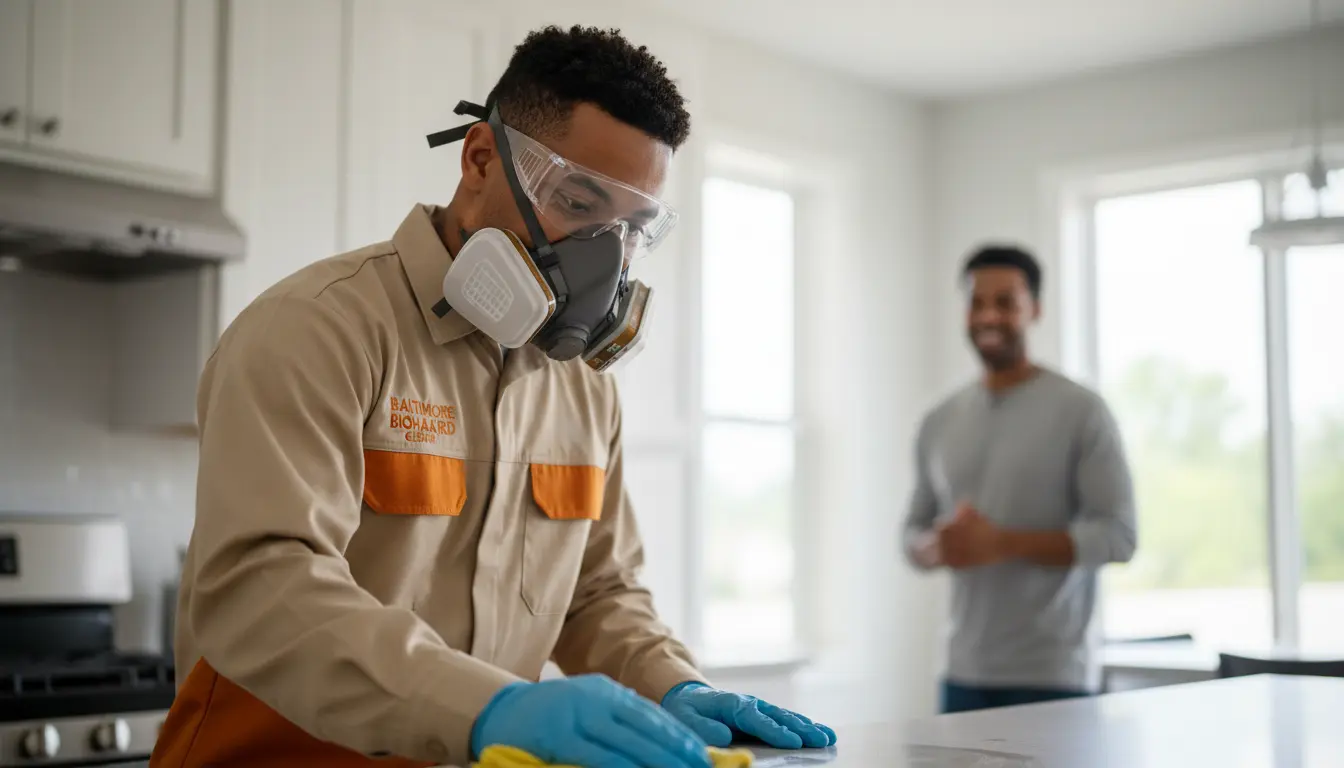
Biohazard cleanup is the systematic process of identifying, containing, removing, and decontaminating biological hazards—such as blood, bodily fluids, human waste, and microbiological agents—from a property or structure where an accident, trauma, crime, or medical emergency has occurred. It is frequently confused with standard janitorial cleaning or commercial disinfection services, but the two are fundamentally different in scope, training, and regulatory compliance. Where a janitorial crew focuses on visible surface cleanliness, a certified biohazard remediation team addresses unseen microbial threats, structural contamination, and the legal requirements for handling regulated medical waste under OSHA and EPA guidelines.
For businesses operating in Baltimore, Maryland, the need for professional biohazard cleanup can arise in settings as varied as a retail pharmacy after an opioid overdose, a warehouse where an industrial accident occurred, an office building where a violent incident or unattended death took place, or a dental practice with a need for proper disposal of contaminated sharps and tissues. Each scenario carries distinct health risks—ranging from bloodborne pathogens like Hepatitis B and C to airborne bacterial agents—that only an IICRC-certified technician can safely address. This article defines the full scope of what owners need to know: the technical process, comparative costs, safety standards, and the clear line that separates a remediated site from one that still poses a hidden hazard to employees, customers, and property value.
Defining Biohazard Cleanup: Why It Differs from Routine Commercial Cleaning
The term “biohazard” covers any biological substance that threatens human health. In a commercial context, this can include blood, semen, vaginal fluid, cerebrospinal fluid, synovial fluid, and any fluid visibly contaminated with blood, as well as tissues, organs, and certain microbiological wastes. The Occupational Safety and Health Administration (OSHA) mandates that any worksite with exposure to blood or other potentially infectious materials must adhere to 29 CFR 1910.1030, the Bloodborne Pathogens Standard. This regulation requires that cleanup personnel be specifically trained in universal precautions, personal protective equipment (PPE) protocols, and proper disposal methods—training that standard housekeeping staff do not receive.
In contrast, a routine commercial cleaning crew is equipped to handle dust, dirt, and common microbes on surfaces. They lack the training to assess the risk of infection from a blood spill, to recognize when porous materials like carpet or drywall must be removed rather than simply cleaned, or to verify that a site is truly free of microbial contamination using tools like adenosine triphosphate (ATP) swab testing. Biohazard remediation follows the IICRC S540 Standard for Trauma and Crime Scene Cleanup, which is a rigorous framework for containment, removal, decontamination, and verification. For any business in Baltimore, understanding this distinction is not merely academic—it is a matter of legal liability and employee safety.
The Technical Process of Professional Biohazard Remediation
Professional remediation begins with a site-specific risk assessment before a single tool is deployed. A certified technician evaluates the type of biological material present, the extent of contamination (visible and hidden), and the characteristics of the affected surfaces. For example, in a Baltimore rowhome that has been converted into a small office, shared walls with adjacent units complicate containment. The technician must also assess the HVAC system, as airborne pathogens can migrate through ductwork. After the assessment, a containment zone is established using heavy-gauge polyethylene sheeting, zippered entryways, and negative air machines that filter the air through HEPA-rated filters before exhausting it outdoors. This step prevents cross-contamination to unaffected areas of the business.
Once the zone is secured, technicians don appropriate PPE—ranging from Tyvek suits and face shields to high-filtration respirators—depending on the hazard level. Physical removal of all biohazardous material follows. This includes not only obvious visible matter but also porous items like upholstery, ceiling tiles, or drywall that have absorbed fluid. Baltimore’s seasonal humidity, which can average above 70 percent in summer months, accelerates the breakdown of biological materials and can cause odor migration into adjacent units or spaces. In older Baltimore buildings with brick-and-joist construction, fluid often seeps into unexpected areas. Technicians use forensic-grade UV lights to reveal dried biological stains that are invisible to the naked eye. After removal, the remaining structural surfaces are cleaned using an EPA-registered hospital-grade disinfectant with a verified contact time of 10 to 15 minutes for viral inactivation. A final verification step—ATP testing—measures the amount of adenosine triphosphate left on the surface. This organic compound is present in all living cells, and a low reading confirms that the biological load has been successfully reduced to safe levels.
The Role of Equipment in Effective Decontamination
The tools used in biohazard remediation go far beyond a mop and bucket. Industrial-grade negative air machines create negative pressure within the containment zone, ensuring that airborne pathogens do not escape into hallways, break rooms, or other business areas. Chemical foggers and electrostatic sprayers apply disinfectants to hard-to-reach crevices, including ductwork and ceiling tiles. Enzyme treatments break down organic matter at a molecular level, which is particularly effective for urine-soaked carpet subfloors or blood that has pooled in grout lines. For businesses that have experienced a traumatic event, such as an assault or a suicide, the use of these tools is critical not only for health but also for restoring the property to a safe, functional state where employees can return to work without lingering fear of contamination.
Another specialized tool is the thermal fogger, which uses a thermal fog to disperse deodorizing agents after the biological material has been removed. This is especially relevant in Baltimore’s older commercial structures where odors can cling to porous brick, mortar, and plaster. Without this step, even after visible cleanup, a business may struggle with an unpleasant smell that customers and staff notice immediately—potentially leading to lost revenue and reputational damage. Professional remediation teams carry these tools as part of their standard kit, whereas a typical cleaning service would not have access to such equipment or the training to use it safely.
Professional Remediation vs. Standard Janitorial Cleaning: A Data Comparison
The following table highlights key differences that business owners should consider when evaluating cleanup options.
| Feature/Metric | Professional Biohazard Remediation | Standard Residential or Commercial Cleaning |
|---|---|---|
| Regulatory Compliance | Adheres to OSHA 29 CFR 1910.1030, EPA waste disposal, and IICRC S540 standards | No specific regulatory framework for biological hazards |
| Pathogen Elimination | Verified via ATP testing: target of <30 relative light units (RLU) per surface | Surface-level disinfection, no verification of microbial kill |
| Structural Assessment | Full inspection for hidden seepage, porous materials, odor migration | Visual surface clean only, no assessment of hidden contamination |
| Personal Protective Equipment | Tyvek suits, full-face respirators, HEPA-filtered exhaust | Latex gloves, possibly a face mask |
| Disposal of Waste | All biohazards packaged, labeled, and incinerated per EPA guidelines | Solid waste thrown in normal trash |
As the table shows, the gap between professional remediation and standard cleaning is not a matter of opinion. It is defined by measurable, verifiable standards. Businesses that opt for a janitorial service to handle a biohazard incident are taking a significant legal and health gamble.
Expert Insights: Three Diagnostic Tips for Business Owners
After reviewing hundreds of remediation cases in the Baltimore area, three diagnostic observations consistently separate a thorough restoration from a surface-level cover-up. First, hidden biological seepage is a real threat. In many older Baltimore commercial buildings—especially historic rowhomes converted to offices—floors often have multiple layers. A blood spill on a hardwood floor may seem contained, but the fluid can seep through gaps between planks into the subfloor. The only way to verify that the subfloor is uncontaminated is to use ATP swabs on the underside after removing a small section of flooring. Without this test, a business may think they are safe when bacteria are still growing in a dark, moist environment below the visible surface.
Second, porous materials like gypsum wallboard, carpet, and upholstery cannot be effectively decontaminated after absorbing biological fluid. The structure of these materials creates a matrix where bacteria and viruses can thrive even after the surface is cleaned. In many cases, replacement—not cleaning—is the only safe option. Cutting corners by cleaning porous items inevitably leads to lingering odors, potential microbial regrowth, and liability risks for the property owner. Third, the use of negative air pressure is not optional. Without it, the contaminated air inside a room will naturally migrate to adjacent spaces through door gaps, windows, and ducts. In a busy Baltimore office building or retail space, this can expose dozens of people to airborne pathogens. A qualified remediator will always establish negative pressure before beginning any cleaning.
Common Mistakes Property Owners Make
A frequent error is using household bleach to attempt cleanup. While bleach is a disinfectant at the correct concentration, it is corrosive, loses potency quickly in the presence of organic matter, and does not clean surfaces effectively. More importantly, bleach does not penetrate porous materials. A business owner may think a surface is disinfected when it is merely bleached white, but the biological hazard remains below the surface. Another mistake is waiting for an odor to dissipate naturally. Odors are caused by volatile organic compounds (VOCs) released as biological matter decomposes—they are a sign of ongoing bacterial activity, not a passing annoyance. By the time an odor lingers for more than a few hours, the microbial growth has already deepened. The third common mistake is allowing untrained employees or cleaning staff into the affected area before remediation is completed. This exposes them to bloodborne pathogens and creates a secondary legal liability for the business owner, as OSHA can hold the employer responsible for workplace exposure.
Understanding Biohazard Cleanup Costs
- Site mobilization fees: Typically a flat fee ranging from $150 to $400, covering the arrival of the containment trailer, negative air machines, and initial PPE setup. This fee accounts for the technician’s travel time and the logistics of navigating Baltimore’s urban layout, where narrow streets and limited parking can delay entry.
- Hourly remediation rates: Most certified companies charge $150 to $250 per technician per hour. A moderate trauma scene in a 400-square-foot room often requires two to three technicians working for four to six hours, resulting in labor costs of approximately $1,200 to $3,600. This includes the time for containment setup, physical removal, chemical sanitation, ATP testing, and final teardown.
- Specialized disposal of biohazardous waste: All regulated medical waste must be packaged in red biohazard bags, placed in rigid leak-resistant containers, labeled, and transported to a licensed incinerator by an authorized waste management service. Disposal costs can range from $300 to $1,500 depending on the total weight and volume of waste generated. A larger scene with heavy porous material removal will push this to the higher end.
Three primary factors influence final pricing: the extent of structural material replacement required, the total volume of biohazardous waste, and whether specialized HVAC decontamination is necessary. For example, if blood or bodily fluids have contacted the HVAC system—entering ductwork or landing on blower components—additional labor and HEPA vacuuming of the entire system will add $800 to $2,000 to the final bill. Another cost modulator is the time of day: emergency after-hours calls in Baltimore, especially on weekends, typically trigger a premium of 50 to 100 percent over standard hourly rates. A business that closes for a day following an incident will also face lost revenue, further emphasizing the value of a rapid, thorough response that minimizes downtime.
Safety Standards and Certifications That Protect Your Business
Certifications are not just badges—they are evidence of training and adherence to protocols that safeguard everyone involved. The most critical certification for any remediation company is the IICRC S540 certification for Trauma and Crime Scene Cleanup. This standard defines every step from initial trauma scene assessment through post-remediation verification, ensuring that technicians follow a consistent, scientifically valid methodology. Without it, there is no guarantee that the cleanup meets any professional benchmark. OSHA compliance is equally mandatory: every employee who enters a biohazard environment must have completed the OSHA Bloodborne Pathogens training, which covers universal precautions, handling of sharps, emergency procedures, and proper disposal. For businesses in Baltimore, these standards are not optional suggestions—they carry the force of law. Failure to follow them can result in fines, lawsuits, and reputational damage.
Another layer of protection comes from the proper chain of custody for biohazard waste. Authorized waste management services ensure that all biological waste is collected, transported, and incinerated at a licensed facility. This eliminates the risk of improper disposal—such as leaving contaminated material in a dumpster where it can expose sanitation workers and the public. Baltimore Biohazard Cleanup follows this chain meticulously, providing a certificate of destruction at the end of every job. For the business owner, this certificate is a critical document. It proves to insurance companies, landlords, and regulatory bodies that the site has been restored by an approved professional using government-compliant methods. Without it, a future claim or audit could be denied, leaving the business owner exposed to significant liability.
Frequently Asked Questions About Biohazard Remediation for Businesses
How soon after an incident does biohazard cleanup need to begin?
Immediately—or as close to immediately as safety allows. The longer biological material remains on a surface, the deeper it penetrates porous materials and the more it breaks down, releasing VOCs and becoming a more difficult remediation case. In Baltimore’s warm and humid summers, bacterial growth can accelerate within hours. A delay of even 12 hours can mean the difference between cleaning a surface and having to rip out large sections of flooring or drywall. Emergency response services are available 24/7 for this reason: quick containment and removal preserve property and reduce overall costs.
Can a business be liable if a cleaning crew handles a biohazard without proper training?
Yes, absolutely. Under OSHA’s Bloodborne Pathogens Standard, an employer has a duty to ensure that no employee is exposed to blood or other potentially infectious materials. If an owner instructs a janitorial employee to “just clean it up,” and that employee is not trained, not wearing proper PPE, and not following disposal regulations, the business owner can be cited by OSHA for willful violation, facing fines up to $70,000 per incident. Moreover, if the employee becomes infected with a bloodborne disease, the owner could face a costly workers’ compensation claim or even a civil lawsuit. It is far safer and more cost-effective to hire a certified remediation provider.
What happens if a property is left uncleaned for several days?
Decomposition accelerates, particularly in a warm indoor environment. Fluids and tissues break down, releasing VOCs that create a strong, often overpowering odor that permeates walls, furniture, and even adjacent rooms. In a commercial setting, this can make the space unusable until a thorough decontamination is completed. Furthermore, insects and pests may be attracted to the site, creating an additional infestation problem. The longer the delay, the more extensive the material replacement becomes. In many cases, what could have been a one-day cleanup becomes a three-day restoration involving structural demolition.
Are there specific regulations for medical waste generated in Baltimore businesses?
Yes. Maryland Department of the Environment (MDE) regulates the storage, transport, and disposal of medical waste under COMAR 26.13.13. Businesses that generate small amounts—like a dental office or pharmacy—are still required to contract with a licensed waste hauler for incineration or autoclaving. Leaving medical waste in a standard dumpster is illegal and can lead to penalties. For a business that has a one-time biohazard incident—such as a violent injury—the cleanup company should handle all disposal and provide documentation of proper destruction to MDE standards. Always ask for a copy of the waste manifest before concluding the job.
Can biohazard cleanup be covered by insurance?
In many cases, yes. Commercial property insurance policies often cover biohazard remediation as part of their liability or property damage clauses, particularly if the incident is related to a crime, a workplace injury, or an unattended death. However, the policy may require the use of approved contractors. It is recommended to call your insurance agent as soon as the incident is reported to understand any requirements for claim filing. A professional remediation company like Baltimore Biohazard Cleanup can work directly with the insurance adjuster to streamline the process, providing the necessary documentation and pricing to expedite the claim.
Professional Biohazard Remediation in Baltimore: The Path Forward
When a biohazard incident occurs in a business, the owner faces a set of high-stakes decisions. Choosing the wrong cleanup route—whether through ignorance, cost-cutting, or a simple mistake—can lead to health risks, legal liability, property damage, and a loss of trust among employees and customers. The right route is to engage an IICRC-certified, OSHA-compliant remediation service that understands Baltimore’s urban and environmental landscape. From the challenge of containing contamination in historic rowhomes to the speed required to outrun our region’s accelerated decomposition cycles, a local expert brings knowledge that a national chain cannot replicate.
Baltimore Biohazard Cleanup offers precisely this depth of capability—a team trained in the most current protocols, equipped with ATP verification technology and HEPA-filtration systems, and dedicated to discreet, thorough restoration. Every job, whether it involves a retail space, an office, or an industrial site, is treated with the same rigorous attention to safety and legal compliance. By choosing a professional service, business owners protect their people, their property, and their peace of mind. The cost of professional remediation is an investment in a secure future—and one that no business can afford to skip.